My Story
About RA
Traditional Treatments
Alternative Treatments
Links to More Info
My Total Knee Replacements
|
. |
Traditional Treatments
Please bear with me ... this is a work in progress.
I will be adding to this page over time, but right now I am featuring information from either the Arthritis Foundation or the ArthritisInsight page on some of the most exciting new treatments for RA, Celebrex, Vioxx, Remicade, Prosorba, Enbrel and Arava. Many long-time sufferers have received incredible relief from these treatments. I personally have tried Celebrex and Arava, but neither helped me to any great extent. Currently I am taking only prednisone and painkillers for my arthritis (I have left out some meds I take for other conditions for privacy reasons), but I've tried, it seems like, practically everything.
Visit the Arthritis Foundation website for more information on new and emerging treatments for arthritis.
You may also want to check out an interesting new site called RemedyFind that allows patients to rate their personal experiences with various treatments. The site has entries on traditional as well as alternative treatment options.
INFORMATION ABOUT REMICADE
from the ArthritisWebSite
After hearing about the clinical trials of
Remicade at the American College of
Rheumatology Meeting in 1998, many
observers were anxious for the drug to hit the
market for rheumatoid arthritis, since it had
already been approved for the treatment of
Crohn's disease. A year later the FDA finally
approved Remicade (infliximab) for use in
the treatment of rheumatoid arthritis when
administered with methotrexate. The drug
offers new hope for people who do not experience an adequate response from methotrexate alone.
Remicade is similar to Enbrel in that it works by binding or capturing excess tumor necrosis factor (TNF).
TNF is a cytokine (messenger protein), and it plays an important role in the inflammatory process of RA.
Remicade blocks the binding of TNF molecules to its receptor sites on cells. By preventing TNF from
binding to the sites, the protein becomes inactive, resulting in reduced inflammatory activity.
Remicade is a powerful drug that is often dramatically effective against rheumatoid arthritis. It is also quite
expensive, costing up to $5,000 per year. It's typically prescribed in combination with methotrexate.
Unlike Enbrel, which the patient must self-inject twice a week, Remicade infusions are administered by the
physician. An initial dose is followed two weeks later and six weeks later by additional infusions.
Additional doses are given at eight-week intervals thereafter.
Note from Robin: I don't know where they get their figure of $5,000 per year for Remicade. In my case, each treatment costs nearly $3,000, which would add up to at least $18,000 per year ... and I have to pay 10 percent of that!
INFORMATION ABOUT COX 2 INHIBITORS (CELEBREX AND VIOXX)
from the Arthritis Website
During the 1998 American College of Rheumatology Scientific Meeting,
researchers presented information regarding Celebrex (celecoxib). The report
concluded that Searle and Pfizer's investigational drug Celebrex relieved arthritis
pain as well as full therapeutic doses of commonly prescribed non-steroidal
anti-inflammatory (NSAID) pain relievers. Merck was also working on the
development of a similar drug, Vioxx (rofecoxib). Celebrex and Vioxx both belong to a class of
compounds called COX-2 inhibitors.
COX is short for cyclo-oxygenase, an enzyme involved in the cascade of cellular events that eventually
produce inflammation. As it turns out, there are two forms of the enzyme, COX-1 and COX-2. NSAIDs
inhibit both enzymes, which is unfortunate, since COX-1 has another job. It produces prostaglandin, a
substance that's critical in the production of a type of mucus that lines and protects the stomach and
intestines. It's the NSAIDs' inhibition of COX-1 that's the cause of their unpleasant gastrointestinal side
effects, including heartburn, ulcers, and bleeding.
COX-2 inhibitors leave COX-1 alone, thus decreasing gastrointestinal side effects while providing the
same analgesic effects as NSAIDs.
On December 31, 1998, the FDA approved Celebrex for relief of the signs and symptoms of
osteoarthritis (OA) and adult rheumatoid arthritis (RA). Vioxx followed and received approval in May
1999 for the treatment of osteoarthritis and menstrual pain and for the management of acute pain in adults.
STATEMENT ABOUT ARAVA
from the Arthritis Foundation
Arava for Rheumatoid Arthritis
Summary
Aravaª (leflunomide) is a new disease-modifying, anti-rheumatic drug that is currently undergoing review by
the Food and Drug Administration. If approved, Arava will be the first new disease-modifying anti-rheumatic
drug developed specifically for the treatment of rheumatoid arthritis in more than 13 years.
It will become another treatment option available to physicians as part of a comprehensive treatment
program, which starts with an early, specific diagnosis of the particular form of arthritis.
STATEMENT ABOUT CELEBREX
from the Arthritis Foundation
Celebrex(TM) (COX-2 inhibitor)
Summary
The Arthritis Foundation believes that Celebrexª, approved by the Food and Drug Administration, shows
great promise in effectively reducing the pain and inflammation of arthritis with potentially fewer side
effects. Celebrex is the first of a new class of drugs known as COX-2 specific inhibitors. The Arthritis
Foundation is excited that millions of people at risk for ulcers and other gastrointestinal side effects from
non-steroidal anti-inflammatory drugs (NSAIDs) may have new treatment options with Celebrex. However,
the Arthritis Foundation notes that the FDA has called for additional studies to prove that Celebrex is
safer than existing NSAIDs.
STATEMENT ABOUT PROSORBA COLUMN
from the Arthritis Foundation
Summary
Based on current information, the Arthritis Foundation believes that early research results for the
Prosorba¨ column are encouraging. It appears that the device, which filters antibodies from patients' blood,
may be helpful in the treatment of the most severely affected rheumatoid arthritis patients. The device is
currently up for review by the Food and Drug Administration.
Full Statement
In people with rheumatoid arthritis, the immune system attacks the joints throughout the body, but
scientists are unclear about what triggers this reaction. It is known that there is a genetic predisposition
to developing RA. The Prosorba column is a blood-filtering device similar to a kidney dialysis machine that
removes excess antibodies from a patient's blood. Initial scientific studies have shown that treatment with
the Prosorba column is particularly suited to the most severe cases of RA. Patients who become resistant to
drug treatments for RA responded positively after using the Prosorba column. The machine is one of several
rheumatoid arthritis treatments under consideration for FDA approval this fall.
The Prosorba column is not a new device. It has been marketed in the United States for 10 years as a
treatment for ideopathic thrombocytopenic purpura (ITP). ITP is a condition in which the body produces
antibodies that destroy its own blood platelets and cause serious bleeding. The Prosorba column is sold in
Canada, certain European countries, China and Mexico. The machine is manufactured by Cypress Bioscience
Inc.
STATEMENT ABOUT ENBREL
from the Arthritis Foundation
Tumor Necrosis Factor Antagonists and Treatment for Rheumatoid Arthritis (Enbrel)
Summary
On November 2, 1998, the FDA gave final approval to Enbrel¨, the first in the new class of drugs that block
the activity of an inflammation mediator in rheumatoid arthritis called tumor necrosis factor. It is expected
to be available by prescription immediately.
As the nation's leading advocacy group on behalf of people with arthritis, the Arthritis Foundation welcomes
this new treatment option and is pleased that physicians will have even more flexibility in designing treatment
programs to meet individuals' needs. The Foundation also encourages the continued use of strategies known to
be effective: early diagnosis and aggressive treatment to limit potential disability, along with self-education
to help those with rheumatoid arthritis participate in the management of their disease.
Full Statement
What triggers rheumatoid arthritis (RA) is not yet fully understood. However, current scientific evidence
suggests that a substance produced by the body, tumor necrosis factor (TNF), may play an important role in
the inflammation process in RA. Researchers have also discovered substances that counteract the effects of
TNF called TNF inhibitors, of which Enbrel is the first to be approved by the FDA. Several studies conducted
in research centers across the country found that patients who used Enbrel had significantly less pain,
swelling and other measures of RA activity. Some participants reported side effects such as mild skin rashes
on their bodies at the injection site and some upper respiratory tract reactions.
These inhibitors, with the FDA's approval of Enbrel (and Remicade, another TNF inhibitor currently under
FDA review), are emerging as new treatment options. Ongoing research will determine the long-term effects
of TNF inhibitors in the treatment of RA. Likewise, more research into the exact role of TNF in RA will also
add to our understanding of the disease's origins and methods to control it -- or one day cure it.
Alternative Treatments
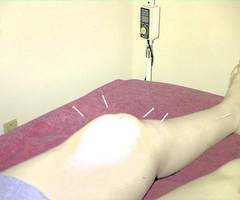 Like many arthritis sufferers, I have sometimes turned to alternative treatments to help me get relief. The non-pharmaceutical treatment that has helped me the most has actually been moderate exercise and/or physical therapy, but another more "alternative" treatment that has helped has been acupuncture. I went to an acupuncture clinic in Austin, Texas. The picture here at left is of me getting "needled." Like many arthritis sufferers, I have sometimes turned to alternative treatments to help me get relief. The non-pharmaceutical treatment that has helped me the most has actually been moderate exercise and/or physical therapy, but another more "alternative" treatment that has helped has been acupuncture. I went to an acupuncture clinic in Austin, Texas. The picture here at left is of me getting "needled."
I also use magnets in my shoes and sometimes wear a magnetic bracelet and/or ring. I've found that magnets do give me some relief from pain and swelling. My doctor feels that, at worst, they are harmless. I get my magnets from Dr. Burke's Alternative Healthy Stores, an online retailer that carries interesting alternative health products such as magnets and magnetic jewelry.
I have tried some herbs and supplements off and on, some with better results than others. Supplements that have helped me are DHEA, SAMe, and omega 3 fatty acids. My doctor does not disagree with my use of these. I get my herbs from MotherNature.com.
Supplements that my doctor has warned me against (either because they are potentially harmful, OR because he just feels they wouldn't do any good) include:
- Melatonin
- Shark cartilage
- Bromelain
- Alfalfa
- Indian ginseng
- Devil's claw
- celery
- ginger
- parsley
- willow
- dandelion
- cranberry
- black cohosh
- feverfew
Visit the RA Achievers Forum on Delphi, where you can leave messages for others with RA, ask questions, and participate in the discussion!
|
